Yahoo – AFP,
Maria ANTONOVA, 19 October 2017
 |
Lake Baikal's high biodiversity includes over 3,600 plant and animal species,
such as this Spirogyra algae |
Lake Baikal
is undergoing its gravest crisis in recent history, experts say, as the
government bans the catching of a signature fish that has lived in the world's
deepest lake for centuries but is now under threat.
Holding
one-fifth of the world's unfrozen fresh water, Baikal in Russia's Siberia is a
natural wonder of "exceptional value to evolutionary science"
meriting its listing as a World Heritage Site by UNESCO.
Baikal's
high biodiversity includes over 3,600 plant and animal species, most of which
are endemic to the lake.
Over the
past several years, however, the lake, a major international tourist
attraction, has been crippled by a series of detrimental phenomena, some of
which remain a mystery to scientists.
'Significant stress'
They
include the disappearance of the omul fish, rapid growth of putrid algae and
the death of endemic species of sponges across its vast 3.2 million-hectare
(7.9 million-acre) area.
 |
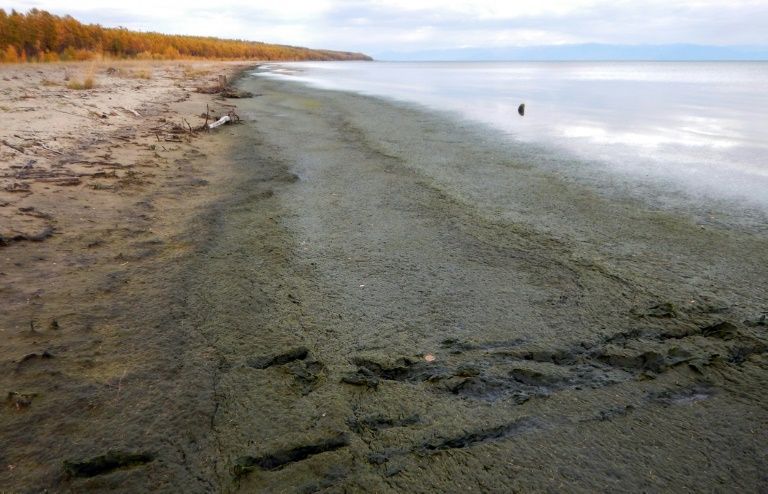
The
shoreline of Lake Baikal is covered by rotting Spirogyra algae
|
Starting in
October, the government introduced a ban on all commercial fishing of omul, a
species of the salmon family only found in Baikal, fearing "irreversible
consequences for its population", the Russian fisheries agency told AFP.
"The
total biomass of omul in Baikal has more than halved since 15 years ago"
from 25 million tonnes to just 10 million, the agency said.
Local
fishery biologist Anatoly Mamontov said the decrease is likely caused by
uncontrollable fish poaching, with extra pressure coming from the climate.
"Baikal
water stock is tied to climate," he said. "Now there is a drought,
rivers grow shallow, there are less nutrients. Baikal's surface heats up and
omul does not like warm water."
UNESCO last
month "noted with concern that the ecosystem of the lake is reported to be
under significant stress" and a decrease in fish stocks is just one
observable effect.
The Baikal
omul, a well-known speciality, was for centuries the main local source of food,
eaten salted or smoked, and especially important given the region has no
farming.
'Not
Baikal anymore'
Another
peril to the lake's ecosystem is the explosion of algal blooms unnatural to
Baikal with thick mats of rotting Spirogyra algae blanketing pristine sandy
beaches, which some scientists say indicates that the lake can no longer absorb
human pollution without consequence.
 |
| Baikal is the world's deepest lake with one-fifth of the world's unfrozen fresh water |
"I am
150 percent sure that the reason is the wastewater runoff" from towns
without proper sewage treatment, particularly of phosphate-containing
detergents, said Oleg Timoshkin, biologist at the Russian Academy of Sciences'
Limnological Institute in Irkutsk.
Fifteen
years ago, some of the lake's picturesque villages had only two hours of
electricity a day, but now improved power access means that "every
babushka rents out rooms and has a washing machine," he said.
Indeed the
lake, which is 1,700 metres (5,580 feet) deep, and its tourism now provide a
livelihood for many residents to replace fishing.
Foreign
visitors often spend time at Baikal while doing a trip on the Trans-Siberian
Railway and in recent years more Chinese have been coming as Russia eased visa
requirements.
Russians
love the area, too, for its hiking trails, camping and spectacular scenery.
Timoshkin
has travelled the length of Baikal testing for Spirogyra prevalence and said
that in three critical zones near populated areas "the bottom does not
look like Baikal anymore" and algae is pushing out oxygen-loving molluscs
and crustaceans.
Near the
town of Listvyanka, the tourist hub closest to regional centre Irkutsk,
"there used to be underwater forests of sponges 15 years ago, now they are
all dead," Timoshkin said.
Money
'stolen'
Last year,
Timoshkin tested 170 types of sponges throughout Baikal's coast, and "only
11 percent looked healthy," he said. "When you take a dead sponge to
the surface it smells like a corpse."
 |
Russian
President Vladimir Putin recently released young omul fish into Lake Baikal
|
If dumping
polluted water into the lake doesn't stop, "shallow coastal zones will
change severely," he said, calling for a ban on phosphate-containing
substances in the region and building "the best sewage treatment plants in
Russia."
President
Vladimir Putin in August complained of "extremely high pollution"
while visiting Lake Baikal, calling its preservation a "government
priority".
A special
1999 law in Russia spells out protection measures for Lake Baikal. The
government is also putting 26 billion rubles (about $452 million, 385 million
euros) into a cleanup programme, which started in 2012, to fund treatment
facilities, though local experts say much of the money gets wasted.
In one
town, Babushkin, on Baikal's shore, millions of dollars were spent on a brand
new treatment plant but bacteria meant to purify the water fail to work in the
Siberian winter, local media said.
"As
usual, the strictness of our laws is compensated by the fact that following
them is optional," said Buryatia-based ecologist Sergei Shapkhayev.
"Money is being allocated but it gets stolen."
Science
funding has also grown thin at a time when studying Baikal is most vital, both
Timoshkin and Mamontov said. "How can you cut funding during a
crisis?" Timoshkin asked.
"That's
like firing epidemiologists during a smallpox outbreak."