Want China Times, Xinhua 2013-10-25
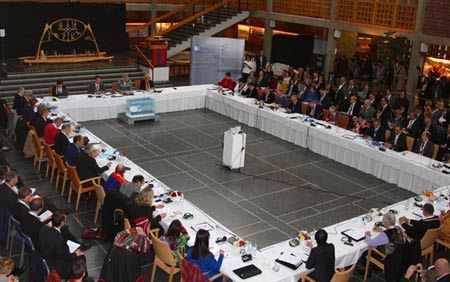 |
| The Arctic Council meets in Kiruna, Sweden, May 15. (Photo/Xinhua) |
China
agreed with the Arctic Council that development in the Arctic region should
abide by local regulations and environmental requirements, according to a
senior official.
China
pledged to make a greater contribution to the council in its new official observer
role, Jia Guide, deputy director-general with the Department of Treaty and Law
under China's Foreign Ministry, said Tuesday in an interview with Xinhua.
Resource development in the Arctic was a possibility, but not a priority for
China, said Jia, who was speaking in the Yukon capital Whitehorse where Canada
hosted the eight-member intergovernmental organization's discussion. He said
the region played an important role in cooling the earth's atmosphere, and any
commercial development would "have to bear in mind the special
environmental requirements."
"We
have to set higher thresholds, or higher standards, for commercial development
in this region," he said.
"When
we talk about commercial development, first and foremost is the respect for
local regulations of the relevant countries. Then comes the concern for
environmental protection. Only with the satisfaction of the relevant
requirements of the local countries and higher (environmental) standards can a
commercial development be carried out," Jia said.
The area
contains 30% of the world's natural gas deposits and 20% of global oil reserves
below its frigid waters, as well as fish, minerals, fresh water and other
resources.
Patrick
Borbey, chair of the Arctic Council's Senior Arctic Officials, told Xinhua the
people of the north wanted development, but not at any cost. He said protection
of the Arctic's fragile ecosystem was paramount.
"We
want to see development happen in the north, the people of the north want to
see development, but they don't want to see it at any cost, at any
expense," he said.
"They
want to see respect for the environment, respect for the wildlife, for the
traditional practices, so that people can reap the benefits of development, but
at the same time we can see sustainable protection of our environment for many,
many generations to come," he said.
China is
one of six new observer countries participating in the Whitehorse meeting for
the first time. The other five are Singapore, Japan, India, South Korea and
Italy. China could never be a full member as the country is not physically
connected to the Arctic, but it could share in and contribute to the scientific
research generated by the organization, Jia said.
Borbey said
it was important to have new observer states from outside the Arctic region, as
decisions and actions taken elsewhere had an impact on the northern-most
region.
"And
we know that the changes that are happening in the Arctic are having an impact
also in China and very, very far from the Arctic. So by working together, by
collaborating, by contributing, sharing our science, I think we can all achieve
better outcomes," he said.
Jia said:
"It is an opportunity for China to make a contribution to the Arctic
Council. By attending the meeting, we feel a high expectation from the Arctic
Council members for the active participation from the observer states and we
are ready to make more contributions in a more active way."
The benefit
of participating in the three-day meetings was primarily from a scientific
point of view, he said.
"Using
scientific research, like following the progress of climate change, and also
the accelerated melting of ice and snow, (one can see that) there is a
possibility for marine passage through the northeast passage that's very, very
important," he said.
At the
current meeting, the Canadian agenda includes promoting development for more
than four million people living in the eight Arctic states, responsible
resource development, and safe Arctic shipping and sustainable circumpolar
communities.
Founded in 1996,
the Arctic Council's full members are Russia, the United States, Canada,
Sweden, Norway, Finland, Denmark and Iceland. Canada, which initiated the
organization through the 1996 Ottawa Declaration, assumed the Arctic Council
chairmanship earlier this year for a second time, a position the country will
hold through early 2015.
No comments:
Post a Comment
Note: Only a member of this blog may post a comment.