Last year,
the private Migrant Offshore Aid Station saved 3,000 migrants in distress at
sea. In view of the surge of people trying to reach Europe in rickety boats,
MOAS hopes to expand its operations.
Deutsche Welle, 20 April 2015
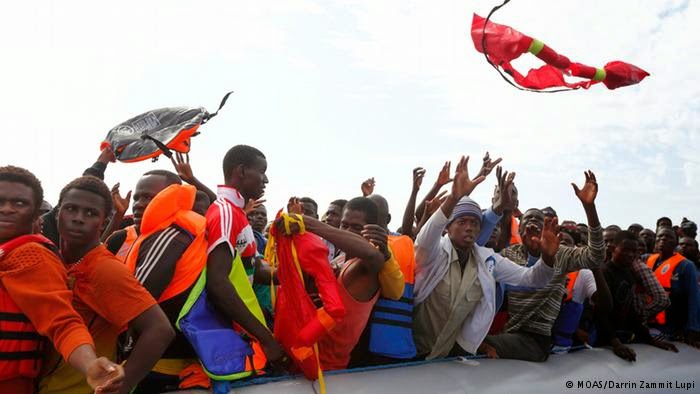 |
| Life vests being thrown to refugees on boat |
DW: How exactly
does MOAS operate? Do you get emergency calls?
Martin
Xuereb: We operate in two ways: reactive and proactive. Reactive in a sense
that normally a boat in distress would contact rescue coordination centers
first. If they call us first, we also call and inform the rescue coordination
center, and, once they're aware of the boat in distress, they will decide whom
to ask to help. If we are close, they would task us. We would go and try and
find the boat. We sometimes use drones. Once the boat is located, we inform the
rescue coordination center and we'll go close and deploy one of our dinghies
with a rescue expert, a doctor, a paramedic and life jackets on board, which
goes close to the migrant craft. We go alongside the boat to determine the
state of the boat and the first thing we do is give life jackets to everyone.
Then we report back on the state of the boat, its size, how many people we
think are on the boat - men, women and children - and, if need be, we do the
rescue.
Last year,
the first boat we assisted was a 12-meter (40-foot) boat with 271 people on
board, including over a hundred women and children, and this boat was already
taking in water. Luckily, they had a bilge pump, but it was already a boat in
distress, so we started the rescue straight away. Once we take people on board,
we are constantly in contact with the rescue coordination center, and they tell
us where to disembark.
 |
| Martin Xuereb retired from Malta's military in 2013 |
The MOAS team
saves people no one else seems to care that much about. What happens to them
after their rescue?
We focus on
saving people at sea. It's not the solution to the migration problem - however,
we say if a person dies at sea, then what happened to him before and what will
happen after is irrelevant, so, as a foundation, what we do is encourage others
to try and solve the problem of migration, tackle the issue of trafficking. The
foundation tries to make sure that these people, who see no option but to cross
the Mediterranean, do not die while they are out at sea.
Who are the
Catrambone family and why are they so committed to helping the refugees - and
privately, with their own money?
Christopher
and Regina Catrambone - he's American; she's Italian - set up MOAS and funded
the operation last year. They feel that people do not deserve to die out at
sea. They are entrepreneurs, but they feel the responsibility to helping people
in distress lies not solely with the state or the EU. They feel civil society
needs to mitigate loss of life at sea, civil society should not be a bystander,
and, rather than talk about it, or write about it, they decided to do something
about it.
How do you
finance the operations?
We are a
private entity, so we need support. People have been donating since November
last year. Over 50 percent of the donations we have received have come from
Germany. We have a MOAS swapsite and a donate button, we're partners with MSF,
and the founders, Cristopher and Regina Catrambone, continue to support us.
However, we still have a long way to go. We hope we have inspired people,
convinced them that migrants do not deserve to die out at sea.
Shouldn't
governments and politicians be doing the job you're doing?
Yes. They
should shoulder the responsibility, remove politics from search and rescue, and
put saving lives at the top of their agenda.
We need to
bring all our assets to bear, to come together and find a solution. The
European states and governments should take the lead, although civil society
and NGOs should be ready to help in this effort.
Martin
Xuereb heads MOAS. He's a Maltese native. During his 26-year military career,
Xuereb oversaw search and rescue missions as Malta's chief of defense. He has
been Malta's representative on the EU Military Committee as well as at the
European Defence Agency, the EU Institute for Security Studies, the EU
Satellite Centre, and NATO's Partnership for Peace program.
Related Articles:
Related Articles:
 |
Pope
Francis met some of those who had survived the trip.
He
challenged everyone to take responsibility for the
migrants' desperation.
|
No comments:
Post a Comment
Note: Only a member of this blog may post a comment.